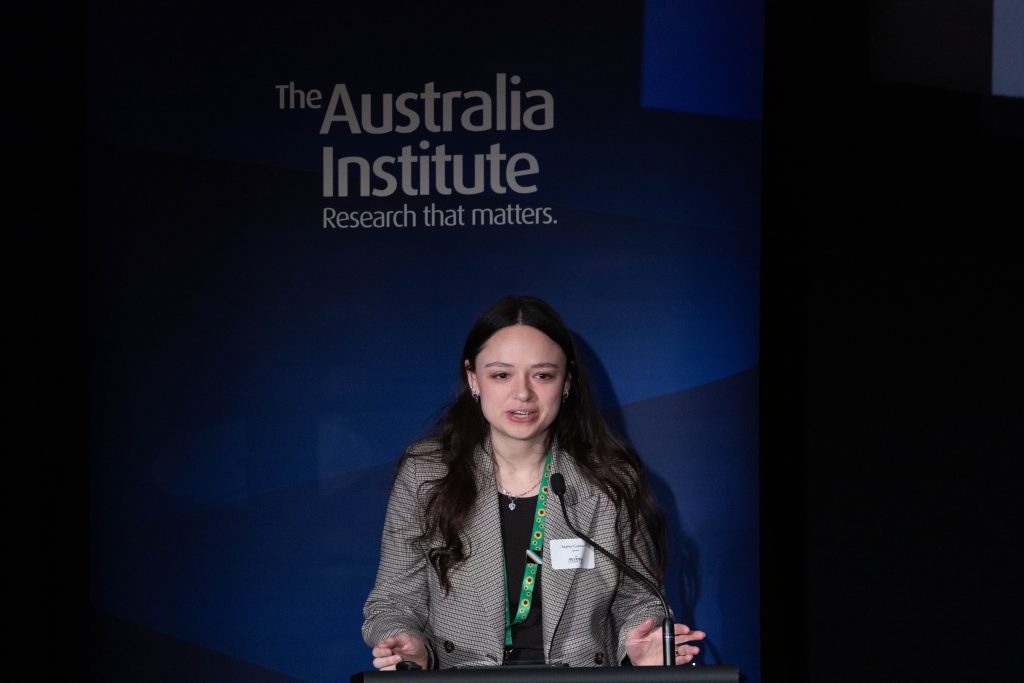
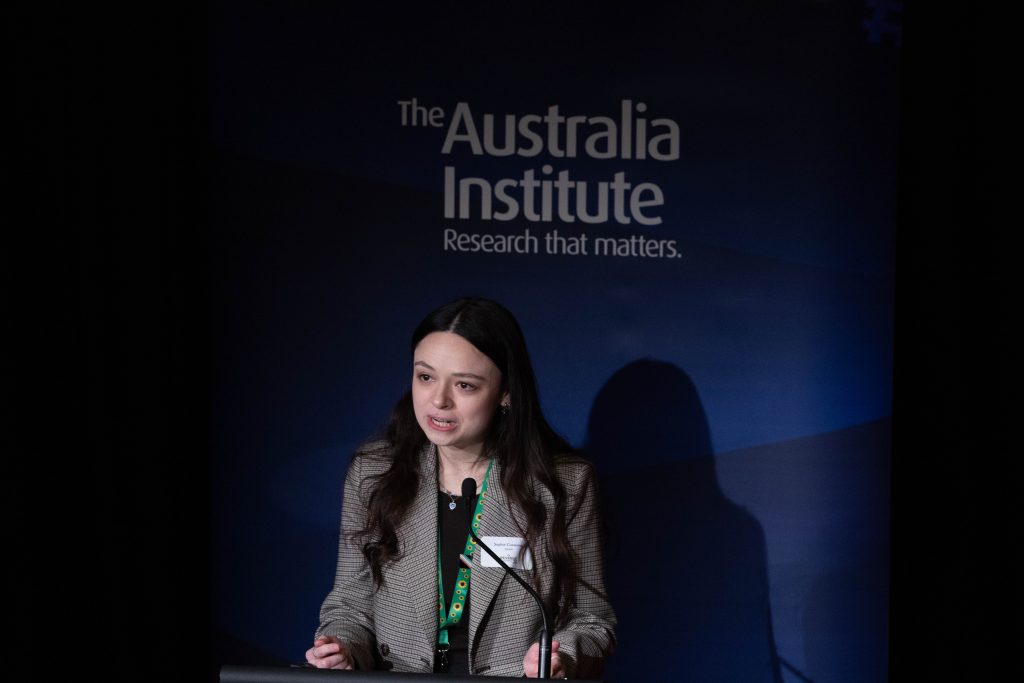
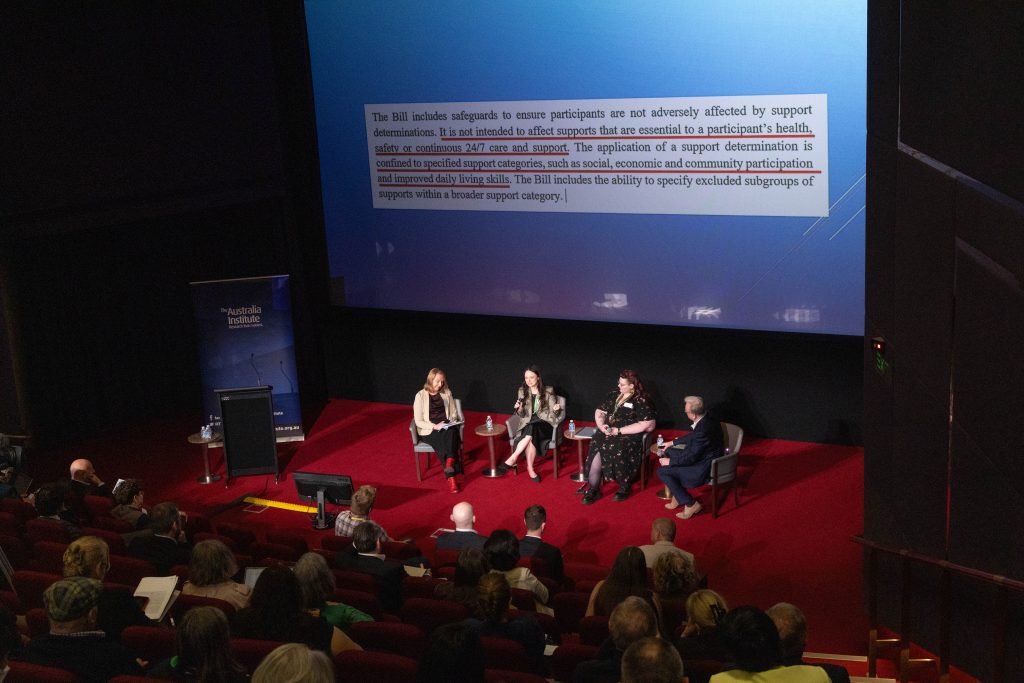
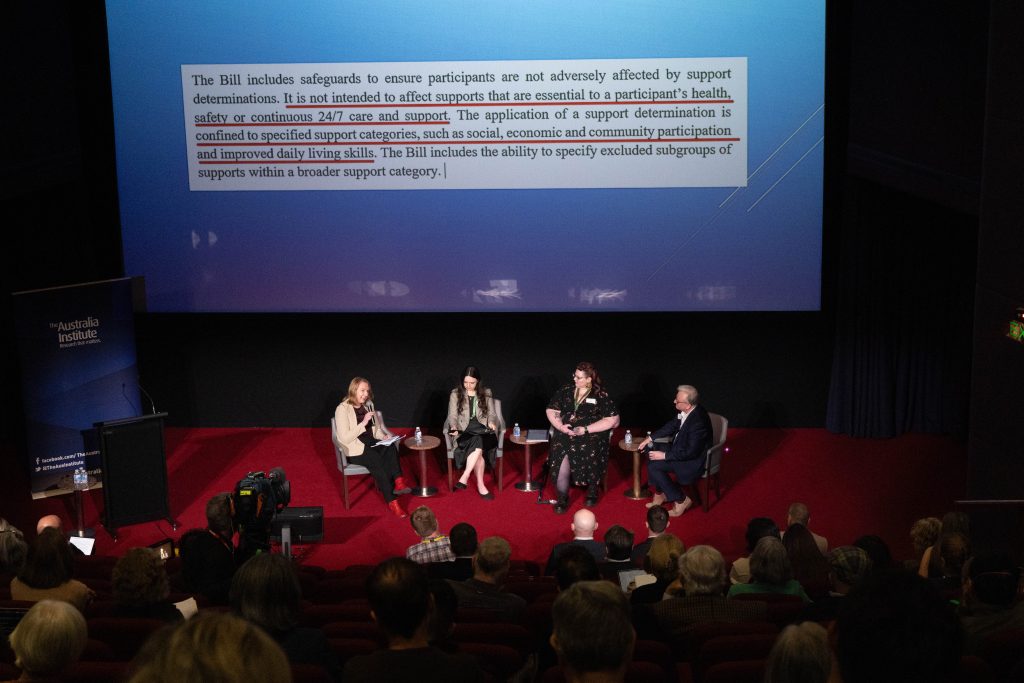
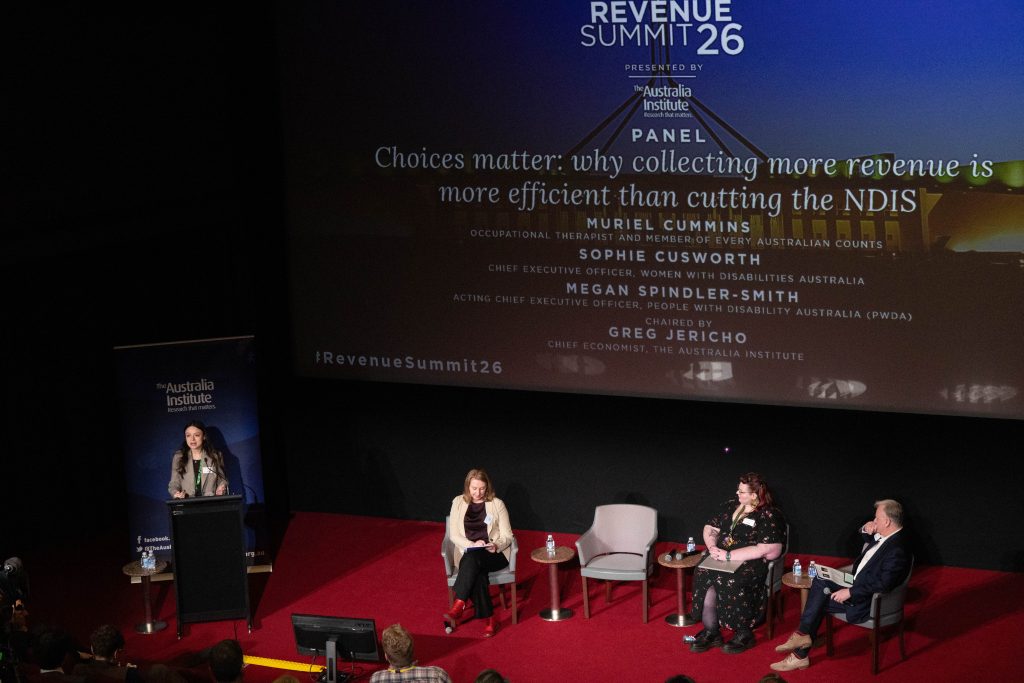
On Wednesday 14 October 2026, CEO Sophie Cusworth spoke at the Australian Institute’s 2026 Revenue Summit on the panel “Choices Matter: Why collecting more revenue is more efficient than cutting the NDIS” alongside Muriel Cummins (President Occupational Therapy Society & Member of Every Australian Counts Steering Committee) and Megan Spindler-Smith (CEO of People with Disabilities Australia).
Read the full transcript below.
The question before us is not whether Australia can afford the NDIS.
The question is what we choose to count as an expense, and what we choose to count as an investment.
And ultimately, who we consider is worth investing in. Australia is consistently ranked among the richest countries in the world. We have an abundance of resources, and a strong economy that gives us the opportunity to provide adequate care for every single Australian.
And the NDIS is an investment that makes an ordinary life possible for hundreds of thousands of people across Australia.
And it is capable of playing real role in advancing gender equality in this country.
The NDIS can determine who gets support, who provides care, who is able to work, and who can live independently.
Who can leave violence, participate in their community, access health care—and who is left carrying the consequences when systems fail. These are gender equality issues. They are human rights issues, and they are productivity issues.
We know women with disability are already underrepresented on the NDIS. We already face lower workforce participation, greater economic inequality, poorer health outcomes and significant unmet need.
Disability supports can enable women and gender-diverse people with disability to work, study, raise a family, and be safe and independent.
But when formal support is not available, we know who so often fills the gaps.
Mothers, daughters, partners and sisters, often at the cost of their own economic participation.
The NDIS already relies significantly on unpaid care, and this carries an enormous economic value.
In 2020, the cost of replacing unpaid care with paid support was estimated at around $78 billion dollars. That is more than twice the cost of the NDIS over the same period.
The Australia Institute estimated that the cuts announced this year equate to around 94 million hours of paid care.
When that care is cut those hours don’t disappear. They become unpaid women’s labour and unmet need.
Cuts to disability supports mean more women pushed out of the workforce because they are now providing more support at home.
Cuts to disability support also means cuts to women’s jobs. Tens of thousands of full-time jobs in care and social assistance services – a sector where women make up close to 80 per cent of workers.
This Government has made significant progress on gender equality, through investing in women’s health, women’s economic security, and the valuing of care work.
But many of those gains will be reversed by decisions that increase unpaid care and leave people without essential supports.
We cannot pursue gender equality with one hand while cutting supports and shifting more unpaid care onto women with the other.
There have always been other choices.
The 2023 NDIS Review called for a connected system: accessible mainstream services, supports outside the Scheme, and the NDIS.
It recommended a range of supports outside the Scheme, that would make the system fairer and reduce pressure on the NDIS. They would support people sooner, avoid higher costs later, and keep people connected to work and community. One example was a national home and community care program, to provide personal care and social support for people who are not on the NDIS.
It is an option we have heard very little about, and just one example of a different choice.
And, we can choose to raise more revenue to fund essential support.
We can choose to invest in a system that supports people with disability to live ordinary lives – one that recognises, redistributes, and values care work – consistent with our national commitments to gender equality.
Because a saving in the NDIS budget is not necessarily a saving for Australia.
When support is withdrawn, cost is shifted.
Health deteriorates. Support needs increase. Families come under greater pressure.
We see more demand for crisis services at public – and human – cost.
We see lost income, reduced workforce participation, and more unpaid care, primarily for women.
These costs may not appear in the NDIS budget. But people, families and governments will bear them.
And there are profound contradictions here.
The Disability Royal Commission identified isolation and economic disadvantage as factors that increase the risk of violence, abuse, neglect and exploitation. Our national strategy for gender equality has identified that valuing care is essential to achieving a gender equal Australia.
But we have responded by withdrawing the supports that help people stay safe, independent and connected. And by cutting paid care work and creating more unpaid care.
So the question is not: can we afford the NDIS?
But rather: can we afford the consequences of these cuts?
What – and whom – do we choose to invest in?
And what kind of country do we want to be?
Photography by Mike Bowers